

Elevating Life Sciences Patents with AI: From Myth-Busting to Real Impact
How AI is transforming chemical and biotech patent drafting — and why practitioners should lean in.
Welcome back to Behind the Claims.
This week, we’re exploring how AI is reshaping drafting and prosecution in the life sciences—not by replacing expert judgment, but by amplifying it.
This Week in IP
As AI adoption accelerates across the patent world, the broader IP landscape is moving just as fast. From major industry gatherings to evolving global guidance on AI-related inventions, this week’s developments highlight how quickly workflows, expectations, and strategy are changing.
Here are the updates catching practitioners’ attention:
IP Service World 2025, Europe’s largest IP convention and trade fair, took place this week in Munich on November 25-26. There were sessions on GenAI in patents, UPC insights, innovation in IP services, and a workshop on the “Ultimate Tool Check” for drafting/analysis platforms, which DeepIP participated in.
If you couldn’t attend, keep an eye on DeepIP’s channels—we’ll be sharing highlights from what we saw on the floor. IP Service World is often an early indicator of where patent-service technology is headed next, especially for teams working in complex domains like life sciences, so our recap will cover the trends worth watching for 2026. Stay tuned…A new Clarivate survey shows AI adoption among IP professionals has jumped from 57 % to 85 % in the past two years. It also flags that governance, domain-specific tooling, and structured input now matter more than ever.
The adoption question is no longer “if” but “how”—for patent teams this means focusing less on whether to adopt and more on how to embed AI safely and effectively.Latham & Watkins gathered over 400 first-year associates for a mandatory two-day “AI Academy” in Washington, DC, signaling that AI isn’t optional anymore in large law firms.
Even outside life sciences or patent-specific work, the message is clear: major firms are embedding AI into lawyer training and workflows now. IP teams should ask: How does our team compare? Are we building the same level of preparedness?
Featured Content
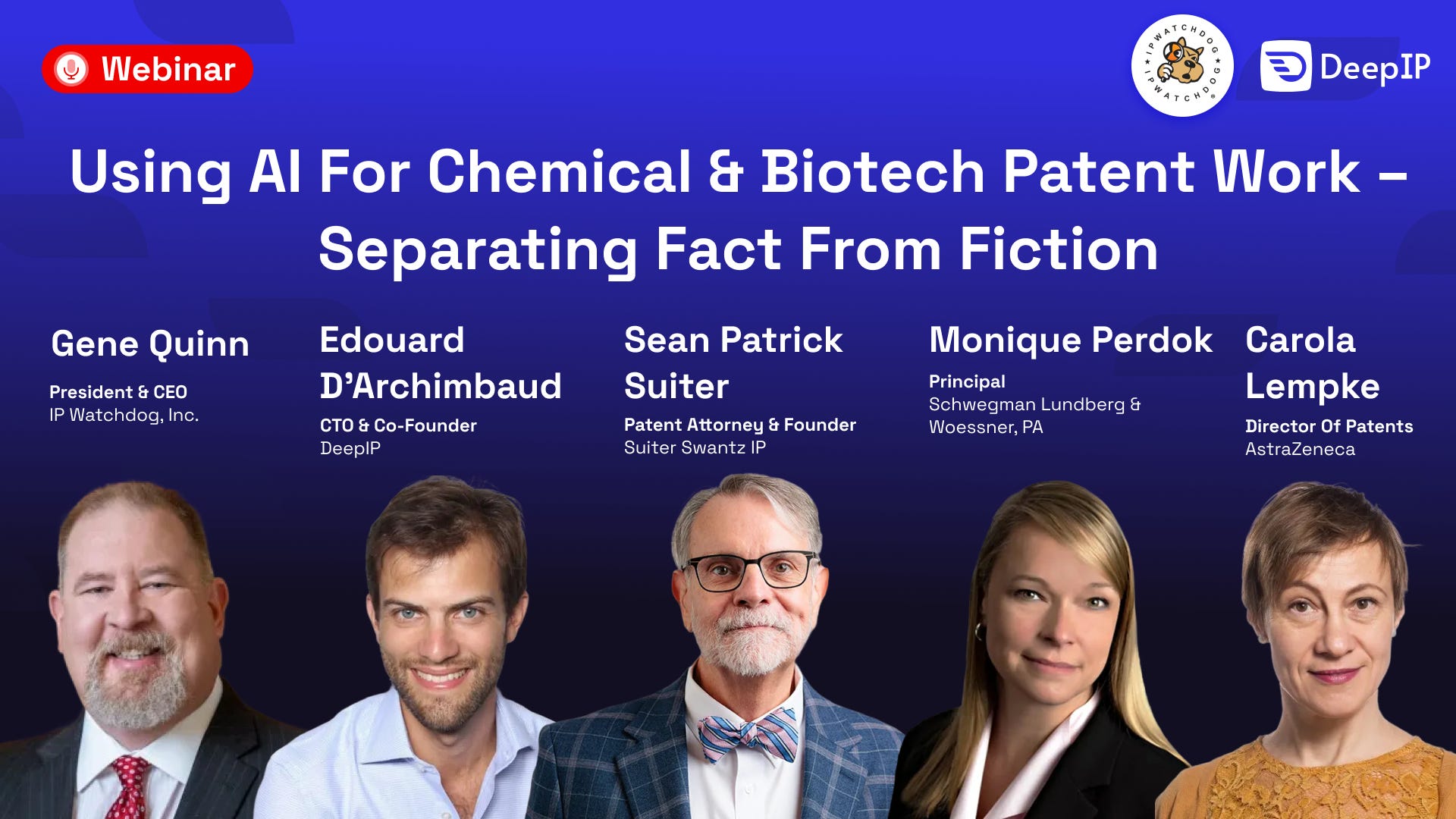
Myth-Busting AI for Life Science Patents
Our featured article distills insights from the recent DeepIP × IPWatchdog webinar (scroll to the bottom of the newsletter for the full replay).
The panel didn’t just discuss AI hype—they broke down where life science patent workflows actually benefit from AI today, and where expectations are still misaligned.
Moderator Gene Quinn (IPWatchdog) led a panel featuring Carola Lempke (AstraZeneca), Monique Perdok (Schwegman Lundberg & Woessner), Sean Patrick Suiter (Suiter Swantz IP), and Édouard d’Archimbaud (DeepIP CTO & Co-Founder).
Together, they unpacked what’s actually happening at the intersection of AI, chemistry, and biotech—and where the persistent misconceptions really lie.
Here are our key takeaways:
AI isn’t a shortcut—it’s a clarity engine
Panelists agreed the first gains show up in structure, consistency, and scientific reasoning, not raw drafting speed.Specialized beats generic
When models are paired with structured scientific data—sequences, chemical formats, examples—accuracy jumps far beyond what general-purpose AI can deliver.Hallucinations are fixable, not fatal
Most errors come from messy inputs or missing context. With domain-specific pipelines, the risk drops dramatically.Security is the real differentiator
Tools vary widely, and life science teams can’t rely on generic “enterprise AI” assurances when handling highly sensitive R&D materials.The workflows don’t need reinventing
The most effective tools embed directly into Word, keeping practitioners in their existing drafting environment.Adoption is accelerating faster than many think
Early movers—including examiners—are experimenting now. Waiting quietly on the sidelines is no longer a neutral choice.
Each of these themes points to a bigger truth:
AI doesn’t replace scientific or legal expertise, it elevates it.
In Case You Missed It
A few complementary reads from past issues and the DeepIP catalog:
▶ Article: Why Your Patent Attorney Should Be Using AI
Forward-thinking firms are already leveraging AI to strengthen claim strategy, improve consistency, and elevate the quality of their applications. This piece breaks down what “AI-enabled” patent practice really looks like—and why clients increasingly expect it.
▶ Podcast: IP Innovators: Building a Tech-Forward Patent Practice: Phil Harris on Automation and AI
Phil Harris shares a candid look at how in-house teams can adopt AI without losing control of quality, confidentiality, or strategic decision-making. It’s a practical conversation about real workflow gains, cultural hesitations, and what responsible automation actually requires.
▶ Webinar: Using AI for Chemical & Biotech Patent Work — Separating Fact from Fiction (DeepIP x IPWatchdog)
The full conversation behind this week’s feature. Hear directly from panelists representing AstraZeneca, SLW, Suiter Swantz, DeepIP, and IPWatchdog as they unpack the biggest misconceptions about AI in life science patent drafting—and reveal what’s working in practice today.
See you next week,
The DeepIP Team
Behind the Claims
The DeepIP recap from IP Service World sounds awesome. What if those 2026 trends includ AI literally writing entire patent apps?