

Agentic Search: Hype or the Next Patent Breakthrough?
Why autonomous, multi-step AI search is becoming foundational to patent intelligence at scale
Welcome back to Behind the Claims.
In our final newsletter of the year, we explore agentic search—the move from query-based patent search to autonomous AI workflows that reason, iterate, and adapt like a human analyst.
From our featured deep dive to recent industry perspectives and a beginner-friendly explainer, this issue unpacks why agentic systems are quickly becoming central to modern patent intelligence.
And before we sign off, we wish you a wonderful holiday season and a Happy New Year.
This Week in IP
One theme is crystallizing across patent tech and AI more broadly: agentic search is moving from concept to capability. What was once framed as experimental or aspirational is now being discussed in practical terms—how autonomous, multi-step AI systems change not just how patent search is done, but how decisions are formed, explained, and trusted.
Below are the recent developments shaping how IP leaders are thinking about agentic search, autonomy, and the future of patent intelligence.
IPWatchdog on Agentic Patent Search’s Broader Adoption
Industry commentators say agentic patent search is no longer just a research prototype—it’s practical and increasingly accessible beyond niche research teams. The focus is shifting toward traceable, explainable workflows that allow users to follow an agent’s reasoning step by step, a critical requirement for legal defensibility in patent prosecution and portfolio decision-making.
The takeaway is that “better search” is no longer just about recall or speed. As agentic systems mature, the real differentiator becomes how conclusions are reached—and whether those conclusions can be trusted, explained, and reused across teams, matters, and jurisdictions.
What “Agentic” Really Means in AI, according to AP
In a recent Associated Press explainer, agentic AI is addressed head-on as a term many dismiss as hype. The article argues that while “agentic” may sound like a buzzword, it describes a real shift: AI systems that don’t simply respond to prompts, but can autonomously plan, act, and adjust toward a goal—behaving less like tools and more like digital collaborators.
This framing matters in IP. Patent workflows are inherently goal-driven—find risk, test novelty, explore alternatives—and agentic AI maps naturally onto that reality. The AP’s point reinforces that this isn’t just marketing language; it’s a signal that AI is beginning to operate in ways that mirror how patent professionals already think and work.
HBR on Why Agentic AI Delivers Real Business Value
A Harvard Business Review report explains that agentic AI—systems that can plan, decide, and act autonomously—is already moving organizations beyond reactive analytics toward decision-driven workflows. Rather than simply accelerating tasks, agentic AI is positioned as a way to improve decision quality, reduce cycle times, and shift human effort toward higher-value judgment.The message translates directly to patent search and analysis—both of which are inherently multi-step, decision-heavy processes. The report reinforces that agentic systems don’t just make existing workflows faster—they fundamentally reshape how complex decisions are explored, executed, and scaled across organizations.
Featured Content
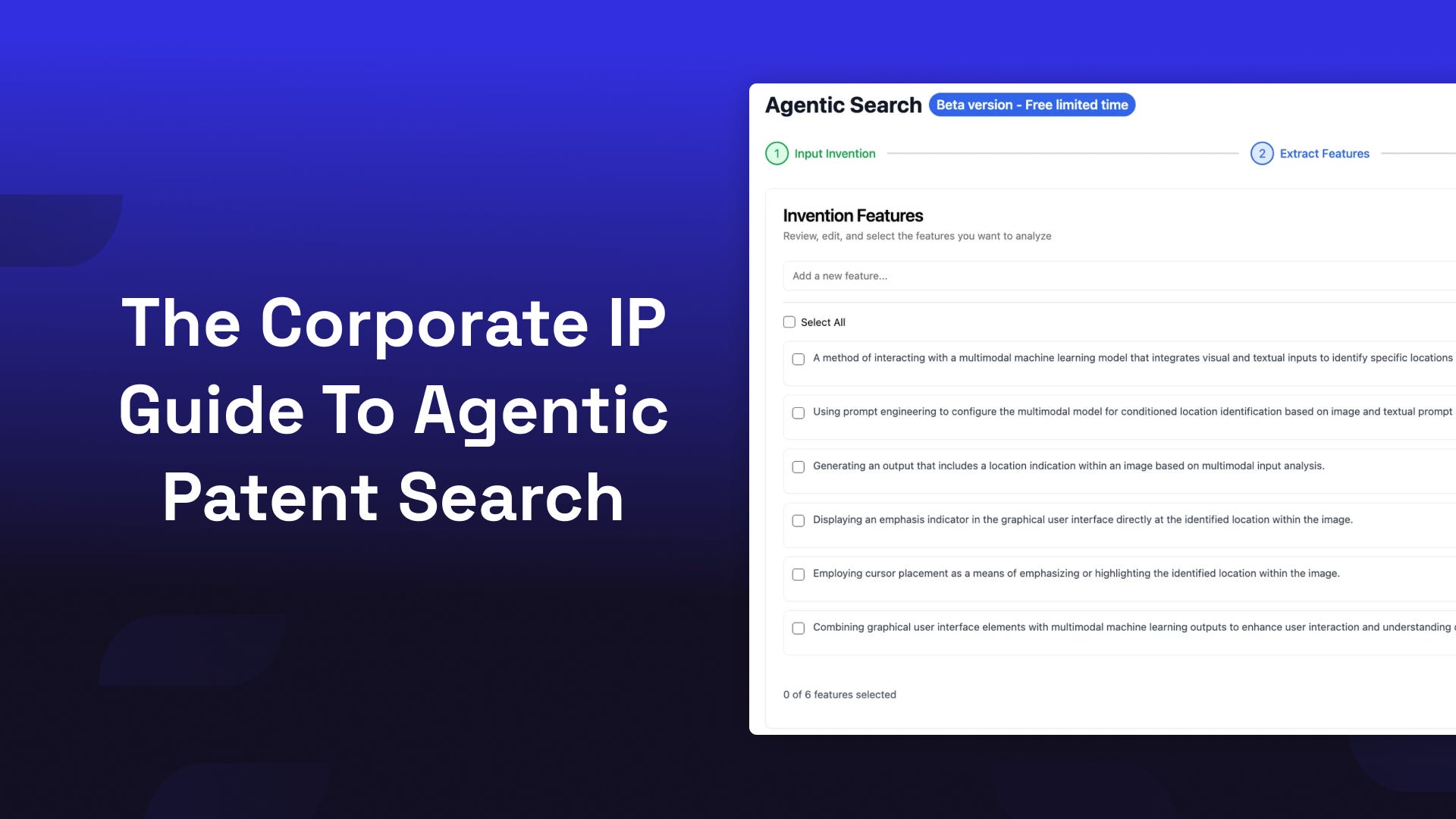
The Corporate IP Guide to Agentic Patent Search
In our featured article this week, we unpack how agentic systems—AI that autonomously reasons, iterates, and expands search horizons—are moving beyond keyword or semantic search paradigms to deliver multi-step, hypothesis-driven workflows.
Why This Matters
Patent search has become both more voluminous and more interdisciplinary. As DeepIP highlights, billions of global filings combined with hybrid technical inventions put pressure on corporate teams to find comprehensive prior art faster and with greater precision than ever before.
Here’s how agentic search is changing the landscape:
Moving past single queries: Unlike static semantic search tools, an agentic system behaves like a tireless junior analyst—reformulating queries, testing alternative interpretations, and exploring functional and cross-domain equivalents.
Deeper evidence mapping: These workflows create transparent evidence chains and audit trails, a boon for §102/§103 analyses and defensibility in prosecution or litigation contexts.
Strategic impact: Teams can identify novelty risks, expand patentability reviews, and monitor portfolios continuously rather than reactively.
Agentic search doesn’t replace human expertise—it amplifies it by taking on laborious iteration and hypothesis testing so IP professionals can focus on judgment, strategy, and risk evaluation.
In Case You Missed It
A few complementary reads from past issues and the DeepIP catalog:
▶ Article: Agentic Search for Prior Art: A Beginner’s Guide to Autonomous Patent Analysis
New to agentic search? This introductory guide breaks down the core concepts behind autonomous patent analysis—what agentic systems are, how they differ from semantic or keyword search, and why multi-step exploration matters for prior art discovery—without assuming deep technical or AI expertise.
▶ Podcast: Trust, But Verify—AI as Every Attorney’s Second Pair of Eyes
In this episode of IP Innovators, Mark Kesslen discusses how AI is increasingly used as a verification layer in patent practice—supporting judgment, surfacing blind spots, and reinforcing confidence without replacing human decision-making.
▶ Webinar: Unified AI Patent Analysis—From Patentability to FTO and Invalidity
Now available on demand, this session explores how integrated AI workflows can support patentability, freedom-to-operate, and invalidity analysis within a single analytical framework—helping teams move from fragmented reviews to more consistent, defensible decisions across the patent lifecycle.
See you next year!
The DeepIP Team
Behind the Claims